

Your resume is worthless.
You, on the other hand, are not. The market for talent is fundamentally broken by design, and every attempt to fix it has only accelerated its collapse.
The resume, a document format essentially unchanged since the 1950s, is now being written by AI and screened by AI, creating a noise-on-noise doom loop spiral that has rendered the entire job application process meaningless.
Meanwhile, 75% of the global workforce (the people companies most want to hire) never enters the application pipeline at all.1linkedin The talent market is a $620 billion industry built on information asymmetry, stale networks, and a 544-year-old document format. Every previously opaque market like it (think commodities, real estate, dating, used cars, financial exchanges) has been transformed by better matching and information layers.
The talent market is next. And the thesis is undeniable:
The perfect job should find you first.
A 544-year-old document is still running the global labor market
In 1482, Leonardo da Vinci wrote a letter to Ludovico Sforza, the Duke of Milan, listing 11 capabilities of his, nearly all focused on military engineering. Only in his final point did he mention art.2kottke The letter was a targeted pitch, leading with the employer's needs. This is something we'd call a cover letter today.
For the next 450 years, the resume barely existed as a genre. Anthropologist Randall Popken documented that resumes first appeared in college business communication courses in 1914.3campanthropology They were called "data sheets" and weren't expected to accompany job applications until the late 1930s. The first job advertisement requesting a resume was in 1952, in Washington D.C.'s The Evening Star, for an automobile salesman position.3
campanthropology Even through the mid-1980s, most job ads didn't ask for resumes; they suggested calling to arrange an interview.
The resume economy has entered a doom loop
The numbers are staggering. The average job opening now receives 242 applications, nearly triple what it was in 2017. As of December 2025, LinkedIn processed 11,000 job applications per minute, a 45% surge from a year prior4shortlistd driven primarily by AI tools and automated resume bots.
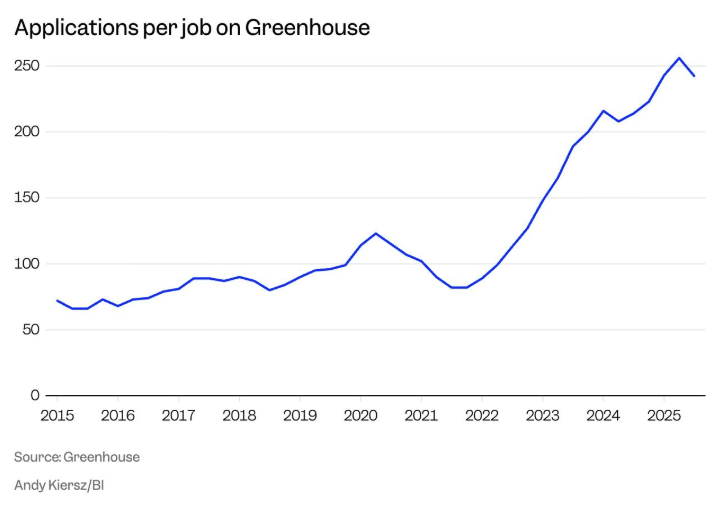
Flash forward to today, and the culprit is a compound failure. The modern-era resume has morphed into LinkedIn Easy Apply and similar one-click tools that double application volume per posting5gighq while producing 70–90% unqualified applicants. A career services study tracking 500 job seekers found that "Easy Apply heavy users" who submitted 150+ applications had a 2.1% response rate and 12% employment rate, while strategic networkers submitting 25–40 applications with active networking achieved a 23% response rate and 58% employment rate: nearly 5x the success 6
autoposting. The tool designed to reduce friction has instead created a flood that drowns both sides.
The recruiter's response? The famous Ladders eye-tracking study (2012, updated 2018) found recruiters spend an average of 7.4 seconds per resume7hrdive. 80% of that time focuses on just five data points: name, current title, previous titles, start/stop dates, and education8
recruiter. Seventy-five percent of job seekers never hear back from employers after applying. And compounding the misery, 27% of all U.S. job listings on LinkedIn may be ghost jobs: postings with no intention of hiring, per ResumeUp.AI's September 2025 analysis8
recruiter. A ResumeBuilder survey found 40% of companies admitted to posting fake job listings, while the Congressional Research Service published a formal report on ghost job postings in April 2025 9
congress.
The result is a system where candidates send hundreds of AI-optimized applications into a void, recruiters drown in volume they can't process, and the signal-to-noise ratio approaches zero.
Bots are now screening bots, and nobody is winning
The AI arms race in recruiting has created a paradox that would be comical if it weren't destroying careers. On the candidate side, 67% of U.S. candidates now use AI tools in their job search. ZipRecruiter found 53% of new hires used generative AI in Q1 2024, up from 25% just two quarters earlier. Tools like LazyApply, Simplify, and JobHunterBot auto-apply to hundreds of jobs per day, and Fisher Phillips estimates 40–80% of applicants now submit AI-generated or AI-enhanced resumes.10fisherphillips
On the employer side, 87% of companies use AI in their hiring process. 99% of Fortune 500 companies use Applicant Tracking Systems.11resumeperk The ATS market alone reached $2.9 billion in 2024, projected to hit $6.3 billion by 2033.12
imarcgroup
Then there's the gaming aspect: Greenhouse's 2025 AI in Hiring Report (surveying 4,100+ people) found that 41% of job seekers admit to using prompt injections (hidden text designed to bypass AI filters), 32% were caught reading AI scripts during interviews, and 18% used deepfakes.13greenhouse Meanwhile, 64% of recruiters report seeing more "look-alike applications" due to AI-written resumes. Only 8% of job seekers believe AI-driven hiring is fair.14
theinterviewguys
Daniel Chait, CEO of Greenhouse, describes this as a "doom loop"13
greenhouse. Candidates use AI to apply to more jobs, employers use AI to filter more aggressively, candidates deploy more AI to punch through filters, and the cycle accelerates.4
shortlistd
Robert Half calls it "the resume illusion": a growing disconnect between what's written and what's real.
Willo describes it as "signal collapse."15
willo
There is no future where candidates using AI to beat AI creates a better outcome for hiring.
75% of the people you want to hire will never apply
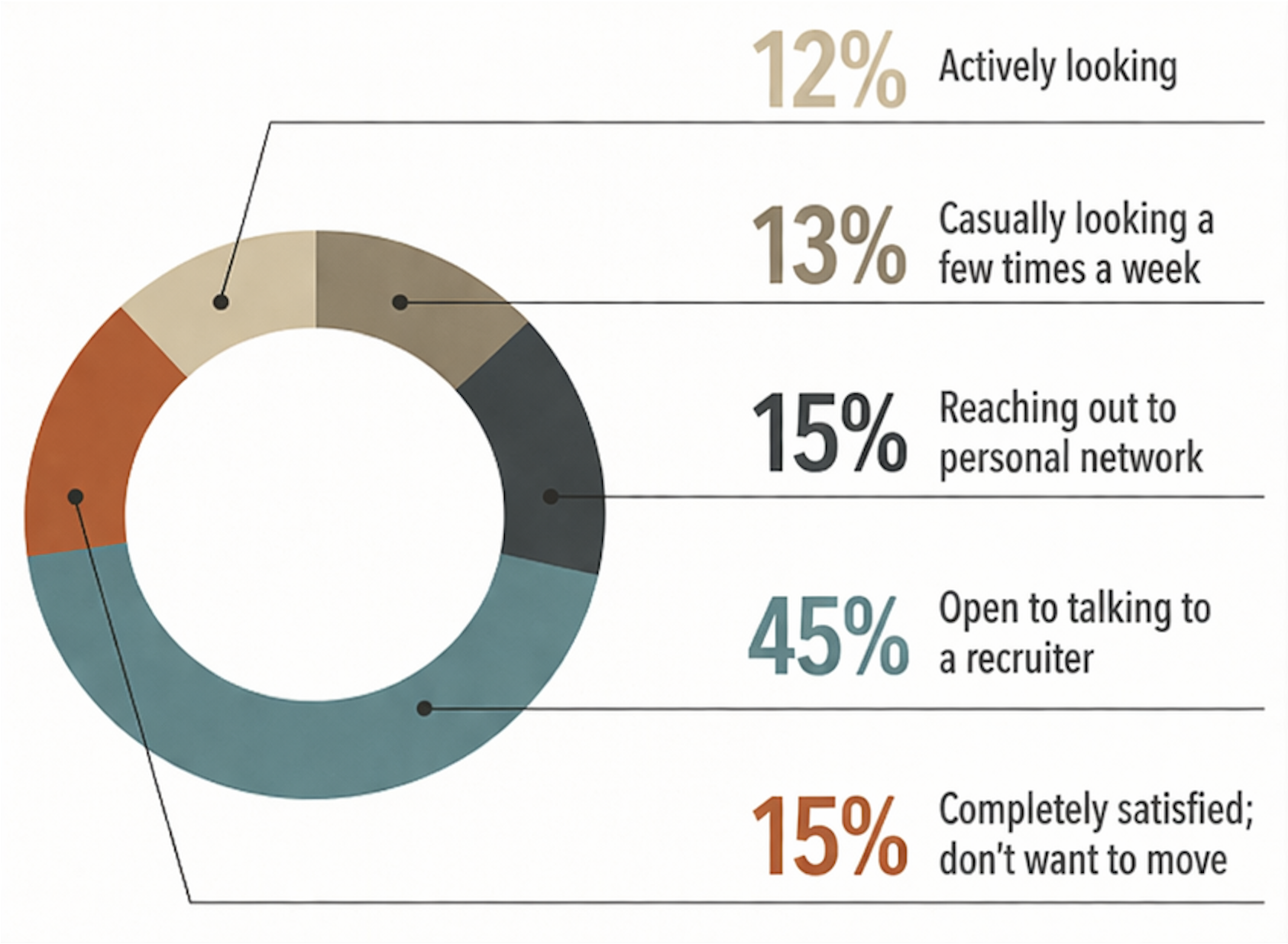
Perhaps the most powerful data point in the talent market is this: 75% of fully employed professionals consider themselves passive candidates, according to LinkedIn's 2014 Talent Trends survey of 18,000 professionals across 26 countries 1linkedin. But here's the critical nuance: 45% describe themselves as "open to approach": totally willing to consider a new opportunity when one finds them.
Combined with active seekers, 85% of the global workforce is "fair game" for the right opportunity presented the right way.
Updated LinkedIn data suggests the figure may now be even higher: 90% of professionals are open to new opportunities if presented the right role 16linkedin.
The quality differential of "fair game" talent is significant too. The data shows passive candidates are 120% more likely to want to make a strong impact at their new employer, 33% more likely to stay long-term, 17myperfecthire and perform 9% better than active counterparts.
The best talent moves through networks that the application economy never touches.
Several platforms have already attempted to crack this:
Hired.com (founded 2012 as "DeveloperAuction") raised $133–165 million to build a marketplace where companies bid on pre-vetted candidates with upfront salary transparency. Engineers loved it. But unit economics deteriorated at scale as quality diluted, 18
underdog and it was ultimately absorbed into Adecco's LHH business unit.
Triplebyte (YC-backed, raised ~$50 million) tried skills-based assessment matching for engineers but couldn't attract enough senior talent at scale and was fire-sold to Karat in 2023.
Vettery (founded 2013) was a success though. They combined AI matching with human "talent executives," 19
techcrunch achieving a 90% candidate response rate and 60% interview acceptance rate. It sold to Adecco for roughly $100 million in 2018, then merged with Hired.
The pattern is consistent: candidates love when recruiting feels like matchmaking, the data validates the approach, but many previous attempts failed on economics, not concept. They relied too little on human curation and blitzscaled into quality dilution.
The missing ingredient for most talent marketplaces was a dedicated headhunter vetting all candidates, preserving quality of the talent pool, and relying on proprietary signals that hiring managers are so desperately clawing for.
The next matching layer will look nothing like a resume
The convergence of failures (e.g., AI-saturated resumes, overwhelmed recruiters, collapsed signal-to-noise ratios, and a passive majority invisible to traditional pipelines) creates both the urgency and the opening for a fundamentally different approach.
The academic evidence points toward what that approach must include. Conscientiousness is the strongest personality predictor of job performance across virtually all job types, according to a & Ones' meta-analysis covering over one million participants across 100 years of data. Emotional stability ranks second. The Big Five personality framework, now validated across thousands of studies, predicts retention 20% better and job performance 15% better than resume credentials alone, per SHL research. Deloitte found 62% of Fortune 500 companies already use personality assessments in hiring. Newer HEXACO trait models explain even more variance in job performance than the Big Five alone.
Who you are predicts job success better than what you've listed on a piece of paper. And yet the entire $620 billion talent industry still runs on the paper.
No major player currently combines psychographic profiling, narrative-based assessment, and a tech-enabled headhunter-driven marketplace where the opportunity finds the talent, efficiently.
The existing players optimize pieces of the broken pipeline. They make resume screening faster, sourcing broader, scheduling automated. They do not challenge the foundational assumption that candidates should apply and employers should filter.
They build better mousetraps for a game that shouldn't be played.
Why Rolodexed
Rolodexed is a talent matching layer that replaces the resume-and-apply model entirely. We are headhunters. We believe in always having a human working with, and ultimately placing the candidate at their dream job.
When you join Rolodexed, you go through a narrative-based assessment designed to capture the signals that would never appear on a resume: your personality, your temperament, how you think, how you work, what drives you, and where your skills have real depth versus surface familiarity. We build a psychographic and competency profile that is richer, more honest, and more predictive than any document you (or your silly AI assistant) could write about yourself.
Then...you do nothing, and let us cook. Our headhunters will always be available to chat, and we'll be working day and night to place you at the perfect gig.
As roles enter our marketplace, the Rolodexed team using our matching engine works on your behalf, continuously evaluating opportunities against your profile and surfacing you directly to hiring managers when the fit is genuine. No applications. No tailored cover letters. No keyword-stuffing for AI's evaluating your resume that will never read past your job title. When the match is right, you get a one-way ticket to an interview.
The perfect job should find you first.
The talent market needs Rolodexed
The evidence is overwhelming. A $620 billion industry produces outcomes where 40–50% of senior hires fail within 18 months. 20salmonbusiness
Application volumes are exploding.
Both sides now deploy AI against each other in a doom loop that has degraded the resume from a professional document to a machine-generated token.
The system of talent acquisition has been optimized for volume, not genuine fit.
Every piece of data, every market parallel, and every economic model says the current system is structurally incapable of producing good outcomes at scale.
Meanwhile, the talent pool that matters most (the 75% who are passive but open to the perfect opportunity) sits entirely outside the system. These candidates perform 9% better, stay 33% longer, and are 120% more likely to make a meaningful impact.
Join the Rolodexed movement now, or be comfortable with drifting away helplessly into the noise.